
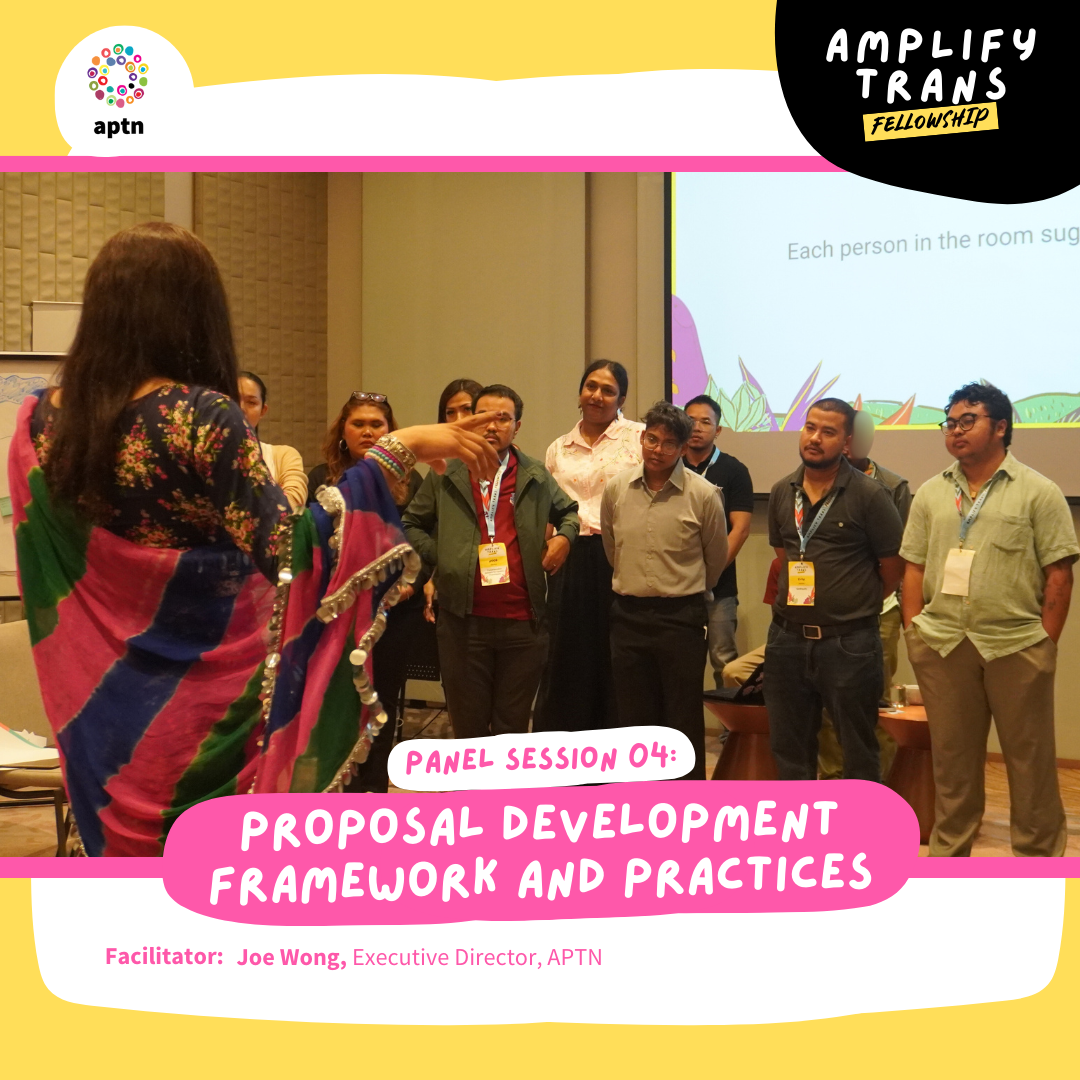
According to the request we have received from many fellows during the programme to learn more about proposal writing, Joe Wong, our Executive Director, led an additional session of the day, bringing the participants together to learn about how best to write a good proposal and present it to donors. The session touched on what makes an attractive and successful grant proposal; and what donors are looking for when reviewing proposals.
Proposal Writing

Fellows were invited to come up with a proposal, and share their idea while describing why it matters.
After each participant shared their proposals, Joe commented that while each of their proposals sound interesting and he would like to know more, funders and reviewers often do not know the full context and are focused on judging proposals based on their thematic priorities.

For example, if a funder calls for proposals related to sexual and reproductive health, but someone applies for funding for a safe shelter project that does not focus on sexual and reproductive health, the proposal would be seen as irrelevant to that donor. Although the work is important, it may not fit the donor’s specific criteria, so it might not get funded.
Therefore, when proposing projects, it is crucial to check the eligibility and what the donors are specifically asking for. When writing proposals, we need to be clear about our goals and ensure that the funds are used ethically to increase visibility for our work and communities.
Step 1: Identifying the problem statement
Funders can also sometimes frame this as context or background, and then ask for your goal and objectives for the activity. They will then ask about the activities you plan to do and the duration, whether it’s 3 months, 6 months, or a year. For your submitted proposal, the timeline is around 3 months.
Joe explained the proposal and emphasized how important it is to clearly define your context. Mental health and well-being may look very different in America or Europe compared to Asia or even vary within your own country. For example, while yoga might support well-being for some, others may need something completely different. That’s why being specific to your own context is essential.
Step 2: Expected outcomes and the total cost
Next, they will ask about the expected outcomes and the total cost. For more complex proposals, they may also ask about your partners and stakeholders. For example, if you are building a safe home, you might partner with a crisis helpline or other nonprofit organizations in your country. You might also collaborate with other safe homes so that when your home is overcrowded, you have other places to refer people to.

Step 3: Partners
If your work involves lobbying the government, like for issuing fresh birth certificates, you need to think about who you can partner with. This kind of big change doesn’t happen in one year, so it’s important to work with those who have the power to make these changes.
Step 4: Sustainability of the program
One question that donors often ask is how you will sustain the program after the funding ends. Honestly, this is a difficult question because our movement heavily depends on funding. If the funding stops, the program often cannot continue. This idea of sustainability is very colonial and corporate-focused while we are not businesses with income or profits.
Instead, the way to sustain our movement is to focus on keeping it healthy, making sure people don’t burn out. So, in our programs, we try to address this aspect of sustainability by supporting the well-being of our communities and activists.

Common mistakes when writing a proposal:
Joe stressed that a proposal is a work in progress and after submission, there is often a feeling of that you could’ve done better in proposal writing. However, it is important to remember that a proposal is always a work in progress, and even experienced writers continue to make mistakes and learn with each new proposal.
One common mistake is making the proposal too big with too little context. The proposal may be in bullet points, and the reader cannot understand what the real problem is. If the donor asks you to write one sentence, it means they want to read something short and clear. So it’s important to follow that instruction.

Another mistake is being too ambitious and overpromising. For example, if someone says they will do 10 workshops in 30 days, that sounds impressive but it may not be realistic. More is not always better. A proposal should be realistic and match the available budget. If your budget is only $2,000, it’s unlikely that you can do 30 workshops. There won’t be enough money to pay people, cover food, transportation, or other needs.
Sometimes, the background of the proposal doesn’t match the activities. This can be confusing. But in your case, many of your activities matched your problem statement and the outcomes you wanted to achieve. That’s a good thing. Some proposals say they want to do one thing, but then list completely different activities.

Another issue is using complicated or fancy language, especially by larger organizations. They might use big words that don’t really say much. For example, the word “intersectionality” is often used without explanation. Someone might say, “We will invite people from all intersectionalities and make it very accessible.” But what does that actually mean? If all the participants are trans, then explain that clearly. Just using the right buzzwords to please the donor isn’t helpful if it doesn’t add meaning to your work.
The key is to be simple, clear, and honest in your proposal. Make sure everything connects: your problem, your goals, your activities, and your budget.
After the session, fellows were separated into groups to get mentorships from APTN team members. The fellows were pre-assigned to groups based on the area of their project proposals matching with the APTN’s staff members who have expertises in the particular areas ranging from Health, Human Rights Advocacy, Movement Building, Campaign, and Artivism. Fellows left day 4 with a holistic understanding of how to manage project implementation, budgets and how to connect with donors effectively through proposals!
 News
News

