
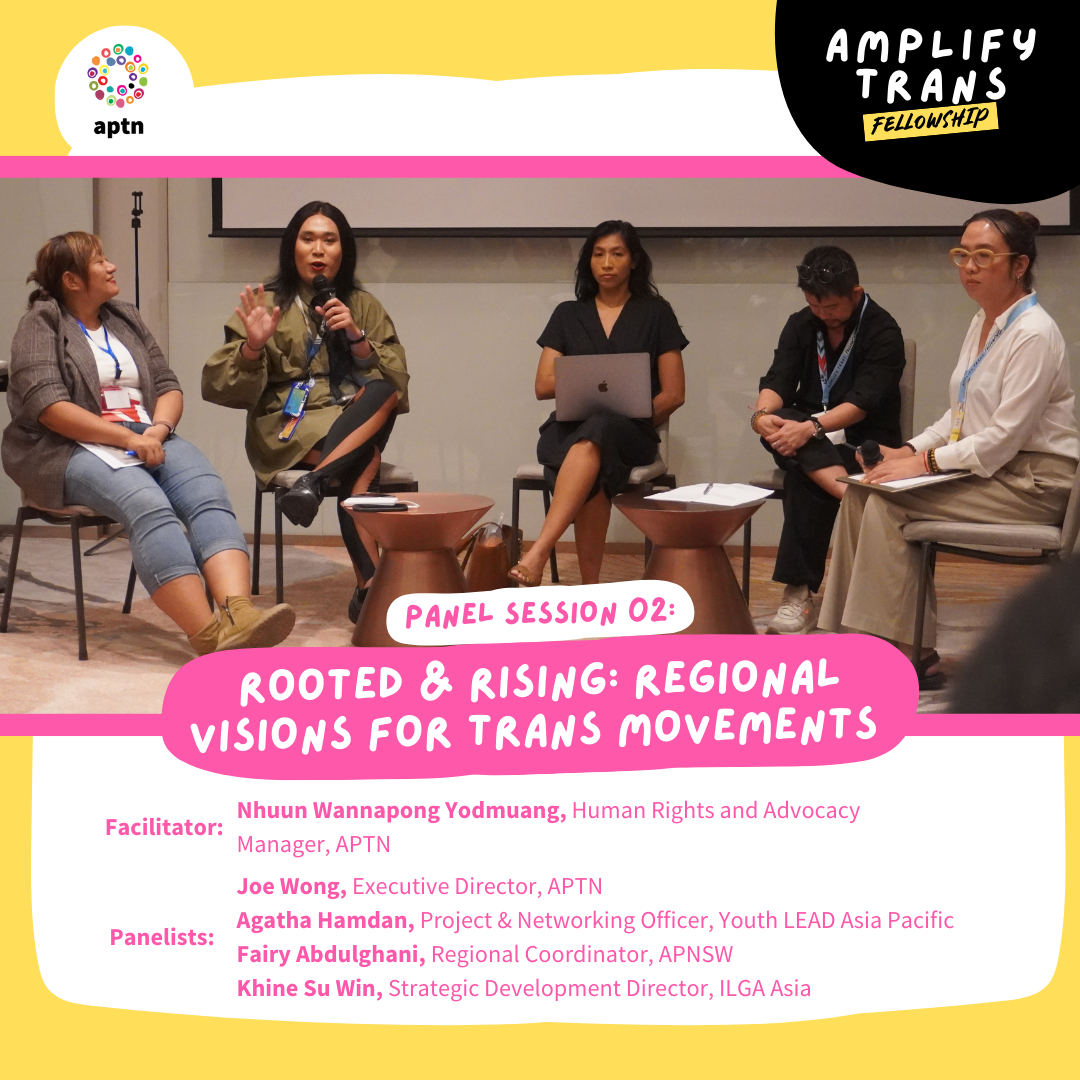
Day 1, Panel Discussion 2
Facilitator: Nhuun Wannapong Yodmuang, Human Rights and Advocacy Manager, APTN
Panelists:
- Joe Wong, Executive Director, APTN
- Agatha Syailendra Hamdan, Project & Networking Officer, Youth LEAD Asia Pacific
- Fairy Abdulghani, Regional Coordinator, Asia-Pacific Network of Sex Workers (APNSW)
- Khine Su Win, Strategic Development Director, ILGA Asia

Rooted & Rising: Regional Visions for Trans Movements
At this year’s fellowship, the session “Rooted & Rising: Regional Visions for Trans Movements” gathered voices from across Asia and the Pacific to reflect on where our movements stand, and where we need to go.
Facilitated by Nhuun Wannapong Yodmuang (APTN), the panel featured Joe Wong (APTN), Agatha Syailendra Hamdan (Youth LEAD Asia Pacific), Fairy Abdulghani (APNSW), and Khine Su Win (ILGA Asia)—each bringing a regional lens shaped by years of community work.
Rising risks and resilience
Khine kicked off the conversation by grounding the discussion in ILGA’s work on human rights humanitarian issues which are intersectional across LGBTIQ+ communities, and highlighting the grim realities trans people face across Asia. From killings in Thailand and Philippines, to imprisonment of trans activists in Myanmar, and the horrific violence against trans people in Afghanistan, she reminded us that these are not only humanitarian crises but anti-gender agendas which are not abstract—they are costing lives.
She also shared that even in countries celebrated as “trans-friendly,” like Thailand, there is still no legal gender recognition. Safe mobility, access to healthcare, and basic legal protections remain out of reach for most trans people.
Her words painted a sobering picture, but also a reminder: the regional struggle is inseparable from the national struggles of our communities.

Lessons from the HIV movement
Agatha reminded us that trans people were part of the HIV response from the very beginning—especially Black and brown trans leaders in the U.S.—yet were quickly pushed aside as the narrative shifted to celebrate cis gay men. “Empowering one group should never mean disempowering another,” she said, challenging governments and donors who continue to resist giving trans people real leadership.
She also brought in the question of class: “If you are trans and wealthy, you don’t need affordable gender-affirming care. You don’t need legal gender recognition reforms. You can simply pay the system. But most trans people cannot afford that. And that’s why we fight.” For her, building solidarity across trans movements means centering those who live in economic precarity, not just those who can access privilege.

Shared struggles with sex workers
Fairy, speaking from the Asia Pacific Network of Sex Workers, connected the dots between trans and sex worker rights. Many sex workers are trans women and gender-diverse people, and both communities face criminalization, violence, and denial of bodily autonomy. “My body, my rights. My body, my business,” she said, explaining how these shared slogans reflect the overlapping struggles of both movements.
Fairy also acknowledged the gaps within their own network, noting the need for deeper internal awareness about trans issues. “We are learning, too,” she shared, describing how APNSW is working to better include trans sex workers in advocacy and policy spaces, including within CEDAW processes. She also raised an often-overlooked issue: the realities of trans men sex workers, whose needs—from HIV prevention to safe abortion—must also be part of the conversation.
Building trans movements from the ground up
Joe reflected on the rapid growth of trans-led organizations—from fewer than 70 in the region a decade ago, to nearly 300 today. But while numbers have grown, the fragility of the ecosystem remains. Most groups are small, informal, and underfunded. Donor expectations often force organizations to “compete” with one another or to fit into frameworks designed in the Global North.
“We are constantly asked to count heads, to divide people into male and female boxes. But we are not those numbers,” Joe said. Instead, the vision of the movement is simple: to improve the quality of life for trans people so they can live with dignity.
He emphasized that APTN’s role is not to dictate but to listen—to honor the history of grassroots organizing, and to push donors toward approaches that respect autonomy, seed new leadership, and resist erasure. “Our work is not only about governments—it’s about negotiating with donors too. Advocacy is making sure our communities aren’t forced to sell their souls for survival.”

Rooted in history, rising in solidarity
What emerged from the session was clear: the trans movement in Asia and the Pacific is not separate from struggles for sex workers’ rights, from the HIV response, or from broader LGBTQ+ advocacy. It is deeply intertwined with histories of colonization, class struggle, and resilience against political violence.
The panelists reminded us that while our communities face growing risks, we are also growing in strength, solidarity, and vision. To rise, the movement must stay rooted—in community, in history, and in each other.
 News
News

 Resources
