
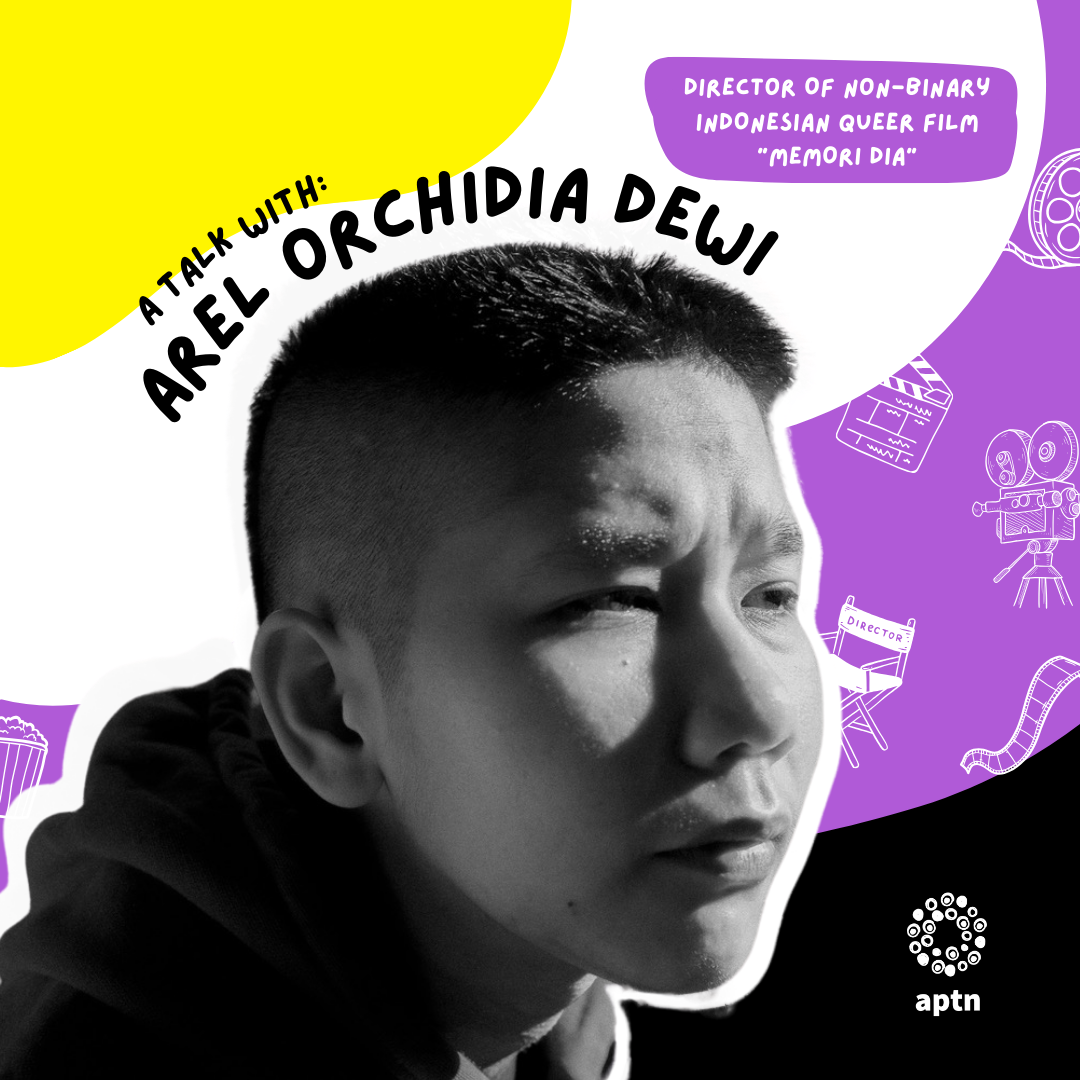
Arel Orchidia Dewi is a non-binary filmmaker that hails from Indonesia, and is currently based in Germany. Their latest film, ‘Memori Dia’, portrays a non-binary person who has grown up in the cisheteronormative society of Indonesia. The film follows Azka as they re-explore their memories of their childhood, and grapples with dysphoria reinforced by societal norms and expectation of how the binary genders should behave.

APTN: Your film beautifully portrays the journey of Azka in their experiences of dysphoria, and their eventual embracing their true identity. What initially inspired you to tell this particular story?
Arel: One thing that has pushed me to make this are my own experiences – a lot of it came out of an initial fear of going back to Indonesia after flying out to Germany to study. Someone asked me what I wanted to do after I graduated, and my immediate response was that I wanted to stay here; going back was not an option.
But after a while, I started questioning myself as to why I was so afraid to go back. I decided to try to dig deep into my own fears and one of them was the place I called home; and the inspiration for Memori Dia started out from there.
APTN: The visual and artistic choices in the film are incredibly interesting. Can you elaborate on some of the creative decisions you made to convey the emotional depth of Azka’s journey?
Arel: I came from a photography background, so using images as a language comes more naturally to me than words do. A lot of elements in the short film was a process of recreating and reinterpreting the home that Azka lived in their childhood. Through the different backgrounds and characters, the team wanted to convey the different layers of childhood that Azka has gone through; including the country, people, family and also their inner sense of self.
Another big decision made was that whenever we depicted young Azka, we decided to have the film shot largely at their eye level, and sometimes people in the background are cut off (with the intention to take this child perspective and experience seriously). We actually even considered never revealing their parents’ faces, but ultimately we decided that revealing it would help with the connection between the viewer and not only Azka, but their family (because a small part of it is also a family struggle of understanding one another, of trying to do what they thought best for their kid) .
In terms of sound and choreography, we decided to make Azka more reserved in their verbal expression as they don’t express their feelings verbally. I wanted to convey the repression that comes with being a queer person growing up in a conservative environment.
APTN: Can you share some insights into your research process and how you ensured an accurate portrayal of the non-binary experience and emotions in the film?
Arel: There was a lot of research that went into the project! We wanted to explore two main questions – one about the public perception of LGBTQ people in Indonesia, and another about the inner perspective of queer and trans non-binary Indonesians.
For the first part of it, we gathered a lot of quantitative and qualitative data about how LGBTQ people are often depicted in Indonesian media – including a lot of Youtube content from the early 2000s and headlines from newspapers and other publications. A lot of attention was paid to the words they used when describing LGBTQ people, and how these media generally talked about them.
I also had some conversations with 5 other trans and non binary Indonesians – about their lives and how they’ve experienced living in a society that has a negative perception towards them. Through these conversations, I learnt that there isn’t one single thing that exemplifies the non binary experience, and it is made of so many different complexities and experiences
Whilst the conversations with the 5 other trans or non binary people were incredibly enlightening, it became clear to me that it was impossible to incorporate all elements of being trans and non binary into a single story – so what I can do is display a portion of those experiences.
I truly think what we need is more stories about more individual personal experiences to make up the full tapestry of how amazing trans and non binary people are.
APTN: Gender identity is a complex and nuanced topic. How did you approach the task of representing Azka’s non-binary identity while also addressing the political dimension of LGBT in your country of origin?
Arel: While I didn’t intend to touch on the political situation, it will ultimately touch on the political situation in Indonesia because of the focus on LGBTQ identities.
I wanted to approach it by focusing on the emotional layer of the lives of non-binary people. I want people to see Azka beyond their gender identity, and more as a person going through stuff like everyone else. From there, I’d like to build an emotional connection that people can identify with, and I believe that from there, people will start to develop compassion for trans and non binary people.
I remembered watching an interview with Alok Menon; they said “”It’s never been about comprehension, it’s always been about compassion.”. I think people don’t necessarily need to understand trans and non-binary people, but they just need to empathize with them. I found that true with my father as well, he doesn’t fully understand my non-binary identity, but he fully supported me and encouraged me to continue in my transition if it meant I would be happier.
APTN: In your opinion, how do filmmakers contribute to LGBT advocacy in your country?
Arel: For me, film was definitely a big part of my life, it was a window for me to see the world through. The film culture of Indonesia was incredibly big. When I was in high school, I used to skip school and go to the cinema, and I think it can be a big influence in shaping and/or forming the perspective of different people.
I’m also optimistic about the growth of queer Indonesian filmmakers! A lot of them aren’t afraid of touching queer topics or including queer characters, be it the main topic or something that’s just there.
“The first time I really saw a trans figure was actually through a film, and that representation was really important to me. I watched the L word when I was younger, and while it wasn’t the perfect series, it was definitely one of the most influential series in the early 2000s. I was still discovering myself so I didn’t see myself as part of their world yet, but it was eye opening for me. I actually learned about chest binding from Max from that series! “
APTN: We heard that there are prominent collaborators that are also identifying as trans or gender-diverse, how do you find these talents within your production?
Arel: I mostly found these contacts through friends of friends of friends – a lot of them was actually found through our producer. I told him that I wanted to create a team that doesn’t necessarily have to be all trans or non-binary, but they do need to have a similar point-of-view despite of how they chose to identify. I wanted them to, in a way, understand the emotions behind the story. There was a lot of focus of queer energy in building the team, and that attracts a lot of queer people in turn.
APTN: The film explores themes of self-discovery, dysphoria and acceptance. What message or messages do you hope viewers will take away from Memori Dia?
Arel: The main message I wanted to give viewers was just to open their hearts for other people and for themselves.Once you accept yourself for who you are, it will create a really beautiful place where everyone can be open and accepting to both others and themselves.
I wanted to spark conversation and curiosity through this film, to be able to poke them and make them think about queer identities and gender norms so a discussion can be started about queer identities and gender norms.
Because of the censorship of media in Indonesia, these topics are not being spoken about or discussed enough, so people often know nothing about queer and trans people; and when they start forming opinions, it’s often based in ignorance. But, it is getting better now because of accessibility through the internet, and I wish to contribute to that.
APTN: What do you learn, personally, within the challenges and success of Memori Dia production?
Arel: There were quite a few challenges involved for this project… Finding the right person to play the protagonist was also tough – it was quite hard to find someone who shared the same experiences as Azka and wanted to be in front of a camera. Because of the political climate, having your identity be exposed to the public was also a big decision for the actor involved. Throughout the casting process, some people also backed out because the story became too personal or too close to their experiences, and it triggered them emotionally.
As for successes, I was incredibly grateful to have the team that I had. Each of us (even cis-identifyng crew members) felt like we were being transformed through the process, and I would not change anything about the team. I’m also really happy that I get to share this with the people in Indonesia. For me, the main goal of this project wasn’t to have it shown in any film festivals or anything, but it was to share the non-binary experiences with the people of Indonesia (and places where being trans or non-binary is still taboo).
APTN: Moving forward, do you have plans to continue exploring themes related to trans identities in your future work as a director? Where can we look for you on social media?
Arel: Definitely, but I want to approach it via different ideas. Right now, i’m still in development, but I want to experiment with different forms of filmmaking and art forms – I want to create something like a hybrid documentary by mixing it with some archival footage and experimental performances.
I’m currently still looking for the team and funding for that project! Films that touch on the topic of gender identity and queerness are always a passion project for me, so I want to take my time and not rush it!
You can find me at @asarela.dewi on instagram!
 Resources

 News
News
