
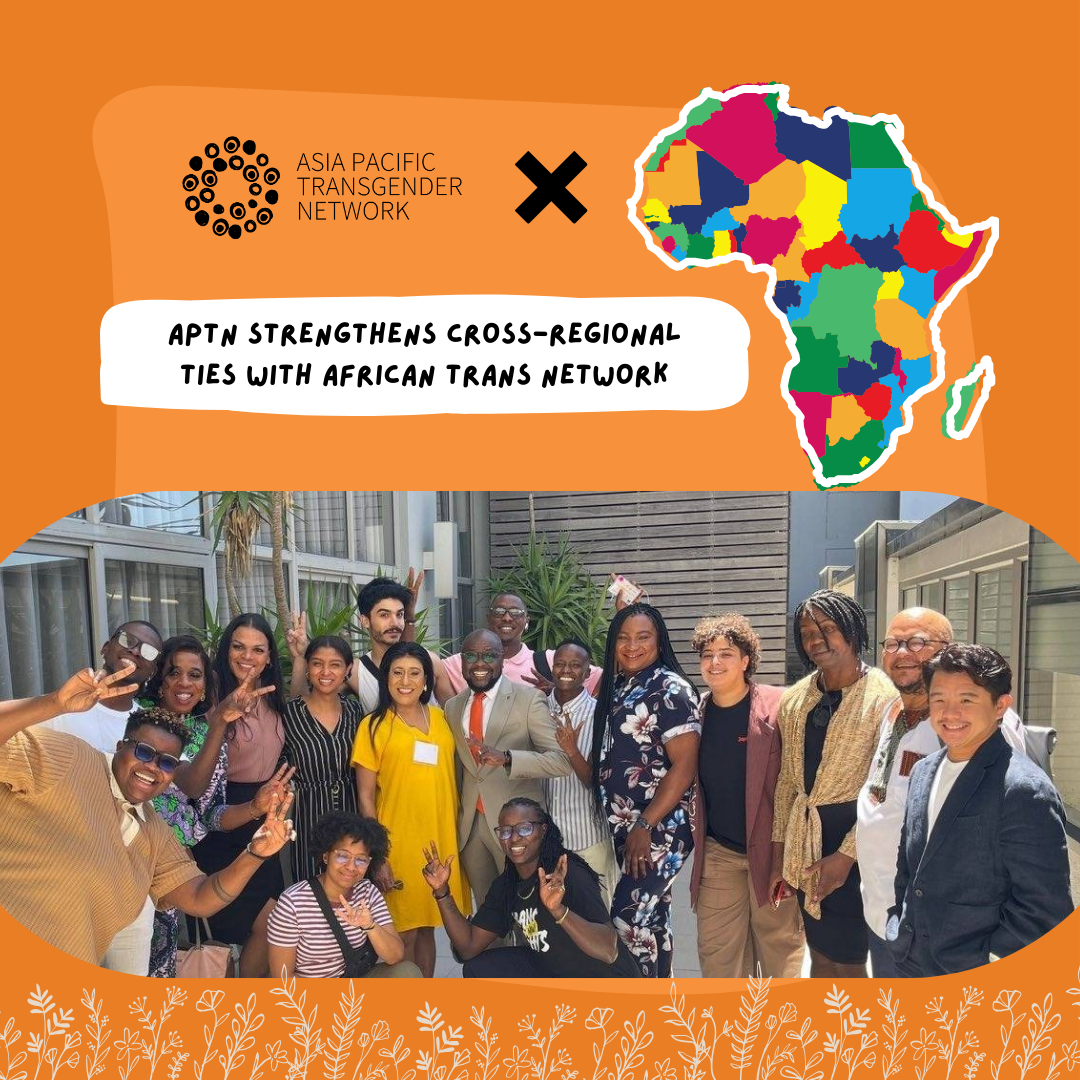
27-28 November 2023
Cape Town, South Africa
This year, APTN continues to work on cross-regional institutional strengthening in the Africa region with the African Trans Network (ATN). With this work, APTN brought together regional African trans activists to reassess the relevance and potential utility of the African Trans Network through the African Trans Network pre-conference titled “Revitalizing the African Trans Movement: Forging Unity and Progress”.
Recognizing the diversity inherent in the African Trans movement, this pre-conference sought to assemble a spectrum of voices, understanding that progress is multifaceted and challenges manifest diversely. Emphasis was placed on ensuring the active participation of these voices, accompanied by a deliberate plan to foster relationships grounded in trust and transparency.
Initially called the Pan-African Task Force, the African Trans Network (ATN) was formed as one of the critical outcomes of the Trans Pre Conference. Comprised of seven activists representing East, West and Southern Africa, the Task Force was established to strengthen the trans movement in Africa, focusing on “strategising on solutions to the challenges facing trans groups and work to advance the priorities of the region”. While intending to forge closer collaboration between the sub-regions already represented, noting the absence of the North and Central African sub-regions, the Task Force from the outset operated with the intention of expanding inclusion. Critically The Task Force committed “to work towards developing a clear roadmap for the trans movement in Africa”.

Day 1: Celebrating Progress and Navigating Challenges
The inaugural day sets a celebratory tone, fostering an environment where the achievements of the African Trans Movement take center stage. The first session “Reflecting on Achievements” becomes a collective pause, an opportunity to acknowledge and honor the milestones reached in the ongoing struggle for recognition and equality.
The second session, titled “Acknowledging Setbacks” provides a space for honest and open discussions about the challenges faced. It is a moment of resilience, where setbacks are not viewed as roadblocks but as opportunities for collective learning and growth. The third session draws the day to a close by inviting participants to collectively envision a unified future through collaborative dialogue and shared aspirations.
Day 2: Forging a Unified Path Forward
As dawn breaks on the second day, the fourth session “Envisioning a Pan-African Future” creates a vision that takes shape, weaving together the diverse threads of experiences and identities, and then the fifth session “Exchanging Strategies for Progress” transforms the venue into a knowledge hub. Strategies that have proven effective in different contexts are shared, creating a repository of wisdom that can be tapped into by activists across the continent. The emphasis is not just on progress but on sustainable and contextually relevant advancements.
In the final session, “Charting the Course Ahead”, becomes the compass that guides the way forward. The collective vision is distilled into actionable steps, forming a roadmap for the future. The course is charted with a commitment to unity, resilience, and progress.
APTN Leading The Strategy Exchange Session
Joe Wong, Executive Director of the Asia Pacific Trans Network (APTN), led sessions on potential ATN structures. He provided insights into APTN’s evolution over 14 years, emphasizing the dynamic nature of organizational structures. Wong highlighted the importance of conducting skills assessments for governance members and shared APTN’s strategy, including subregional consultations for inclusivity. Notably, the coordinator or Executive Director determines the work plan, while the steering committee approves the organization’s strategic vision. APTN supports small groups, connecting them with donors, and advocates for less stringent donor requirements, prioritizing organizational strengthening.

Aside from learning about organisation structures and strategic prirotities. Participants were interested in learning more about the health initiatives and advocacy efforts under APTN strategic pillars that have carried out. In the subsequent group discussions organized by subregions, participants addressed key questions: drawing from their experiences, they shared 1-2 practices contributing to movement building. They also deliberated on the essential components of ATN governance, encompassing terms of reference, terms of service, structure, and more. Furthermore, participants explored strategies for the elected ATN steering committee/board to sustain these conversations post-consultation.
In conclusion, the two-day consultation marked a significant milestone for APTN and the African Trans Network (ATN) as it embarked on a journey to strengthen ATN’s structures.The meeting’s emphasis on learning from other successful regional networks, such as the Asia Pacific Transgender Network, demonstrated a forward-looking approach. As the ATN charts its course toward a more cohesive and impactful future, it does so with a renewed sense of purpose, guided by the lessons learned, challenges acknowledged, and a shared commitment to creating positive change for the transgender community in Africa.
 News
News
