
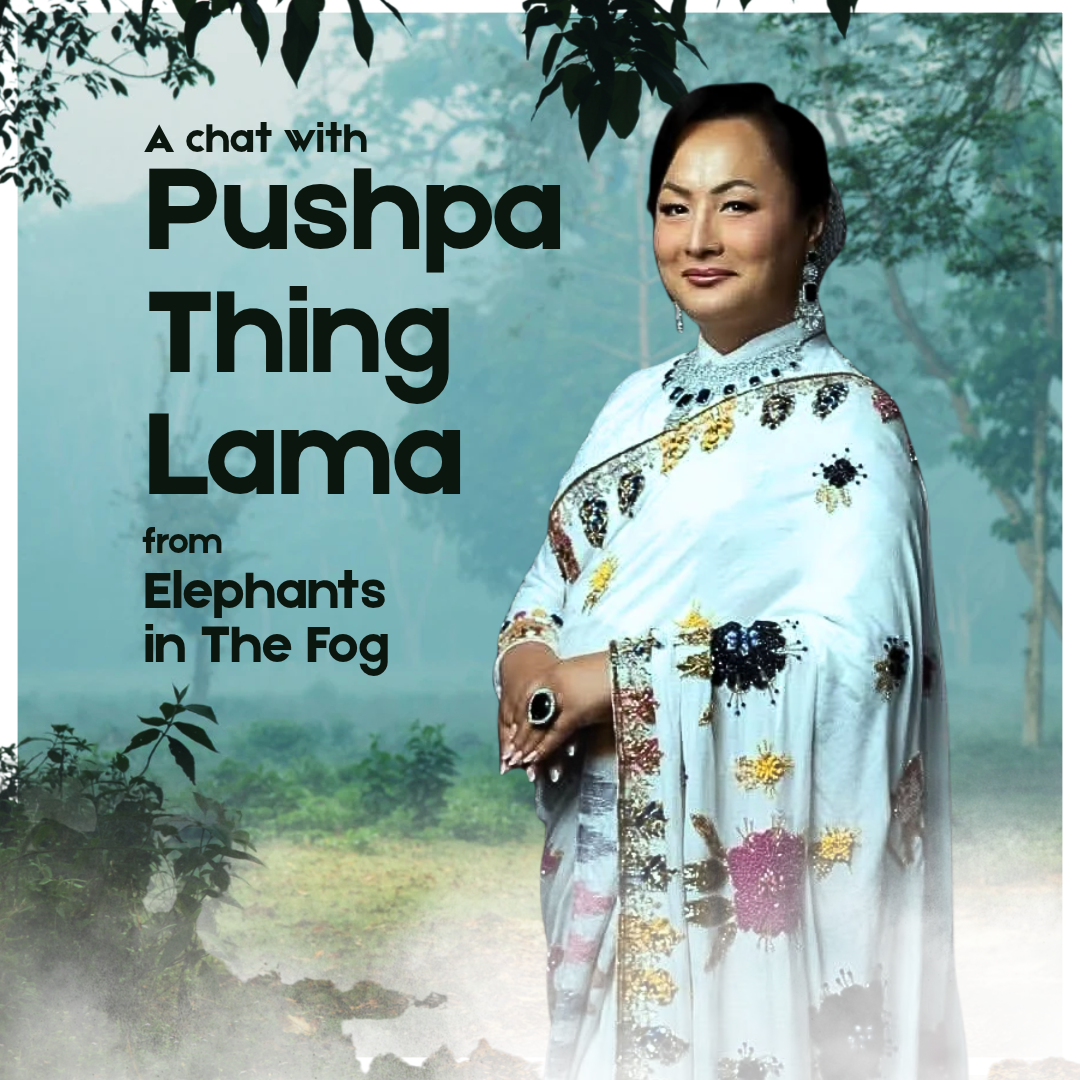
We recently managed to sit down with the main actress for the latest trans Nepalese film, ‘Elephants in the fog’! This film heavily features the Kinnar community in Nepal, and focuses on a trans mother-figure trying to find her daughter after she has gone missing during a night patrol.
Pushpa: Hello and Namaskar. It’s me, Pushpa Thing Lama, an actor and activist for LGBTIQ, Queer People. Since 2005, I’ve been working for LGBTQ rights, and HIV prevention for the MSM and transgender population.
Please tell me about what the movie is about, and what characters you’re playing!
Pushpa: The name of my character is Pirati, which is the main lead of the house. She stays with her chosen family in the remote areas of Nepal, and takes it upon herself to look for her chosen daughter, Apsara, when she goes missing during a patrol.
At its core, it is a story about a mother and daughter relationship within a chosen family. The director, Abinash, has provided us with the opportunity to shed light upon the community. The film really highlights the humanity of our community, and allows us to showcase our lives and the lives of the Kinnar people authentically; helping us turn the invisible visible.
What drew each of you to act in this film, and do you think there are any parallels between your life and your characters’ life?
Pushpa: At first, I wasn’t interested in becoming an actress and acting in this film. But the director came and talked to me about the movie’s story, and his interest in the Kinnar community became clear to me. After understanding more about where he was coming from, I felt that this was something that I should do because a lot of our stories and lives are hidden, and this was a chance to positively showcase the humanity of the trans community.
Embodying Pirati was a very special process for me as well. There was a lot of group workshops and conversations that i had with the team to read the story and build the character. Along the way, I realised Pirati’s life and my life are actually incredibly similar. I really related to the character, because her goals are incredibly similar to mine – in a sense, this is my story as well.
In the film industry, transgender characters are not usually treated well – often,they are only used for comedy, or to fulfill a quota. This character gave me a chance to show the reality of transgender and Kinnar lives and subvert the negative associations that people have of the transgender community, such as the misconception that all of us are sex workers.
This is your first role in acting; what was it like dipping your toes into the world of acting?
Pushpa: Before I acted in this film, my main job was as an activist for transgender people. I didn’t know how to act, and I didn’t have any plans to go into acting either.
It’s actually quite a funny story about how I got into this film. I received a phone call from one of my friends, letting me know about this opportunity. I was skeptical, but I went along with it, and scheduled for the casting director to come to my office to talk more about it.
When the day came, the casting director was incredibly late, and I screamed at him because I had a very important meeting with stakeholders that I had to attend. Ironically, I think that was actually what the casting director was looking for, and after they told me what the story was about, I eventually agreed to the role.
For me, this is not just a movie, but it is also a reflection of my experiences as a trans woman. When I was a teenager, I was constantly bullied and teased for simply being who I was. A big reason I finally agreed to the role was because I wanted to show its audience that transgender people and the Kinnar community are just people who deserve respect, dignity and the right to all that we need to thrive, not just survive. Sometimes I feel that people deliberately complicate any issues related to transgender people, when all we need is to be treated like any other human being.
How was your previous background working in activism and how it helped you prepare for these roles?
Pushpa: I’ve worked as a project coordinator in Blue Diamond Society, where I stay in the southern part of the Nawalparasi district – and I work mainly with HIV prevention for the MSM (Men who have sex with men) and Transgender population, as well as advocacy for LGBTQI rights. I’ve joined BDS since 2015, and it has been a complicated journey – people don’t take our issues very seriously, and our voices are always suppressed.
However, I find great pride in being transgender, and it is my goal to not only I want to share my experiences and my voice to the rest of the Nepal, and to the rest of the world. A big reason being in this film appealed to me was because I wanted to share my voice and spread awareness about the potential of what we can do as trans people.
Currently in Nepal, a friend of mine (Bhumika Shresta) who has been in parliament since March 2026, and has represented our community, and someone from our community has climbed Mount Everest as well.
This movie heavily explores the Kinnar community in Nepal – can you explain what the Kinnar identity or community is to people who might not be familiar with it?
Pushpa: To understand the Kinnar community, you have to understand that it is more than just being transgender. The Kinnar community is very spiritual, and their identities are believed to come from the Gods in Hinduism. They are recognized in the Granthas and the Vedas (Hindu scriptures), and they are believed to be incredibly powerful – with the ability to bless or curse people as well. I may not be a Kinnar myself, but i respect them a lot.
In Nepal, India, and other South Asian countries, we believe that the Kinnar are incredibly powerful. They are said to have the ability to bless people, and have been here since the Satya Yuga (the first age of the Yuga cycle in Hinduism).
Within the film, there are strong themes of found family, and its importance for queer people. Can you tell me what found family means to you, how it appears in your life, how it compares to the movie?
Pushpa: In the movie, there is extremely strong support between Pirati and Aspara – we see strong bonds, love and respect. When Aspara gets lost, Pirati chooses her daughter above all else and is able to stand up for her when no one else would
Similarly for me, my chosen family is my strength and my power. Every person needs a family. To me, my relationships with my chosen family is very important to me too; it reflects our humanity and strength, and we need to surround ourselves with people who respect and care about you to thrive.
In fact, I think we need to start stating the importance of found family. I feel that a lot of trans and queer people are separate from their family and staying alone, and they are cut off from support systems that can help them.
Nepal has been hailed as one of South Asia’s most queer friendly countries – recently same sex marriage has been legalized, and a trans legislator has been elected as well. As a trans person living in Nepal, what are your lived experiences in your country, and do you think any areas can be improved?
Pushpa: Nepal is definitely very queer and trans friendly – we have achieved a lot of things in our country when it comes to rights and legislations. We have been recognized for citizenship and passports, same sex marriages are legal, and we also have a trans member of parliament in office as well. All in all, I am proud to say that I am Nepali.
However, it’s not without its challenges. A lot of people are still clueless about LGBTQ people, and are still learning about queer people in general. However, I will say that we are improving day by day.
I think in general, Nepal is a very safe country in terms of queer acceptance – most people have love and respect for queer people and each other. I highly recommend people come for the beauty and nature!
Finally, do you have any advice or encouragement for trans folk who are living in this current global political climate that is incredibly hostile towards us, who might be feeling dejected or hopeless?
Pushpa: Don’t give up. Be yourself, be kind, and never let yourself down. Fight for your dignity, your voice, and most importantly, fight for your own rights. Please continue being yourself, live with your own dignity, and never let people get to you.
Hope is very important – it is something that we can never lose. Some day, we will be recognized by nations and the world; and it will be a very proud moment for trans people.