
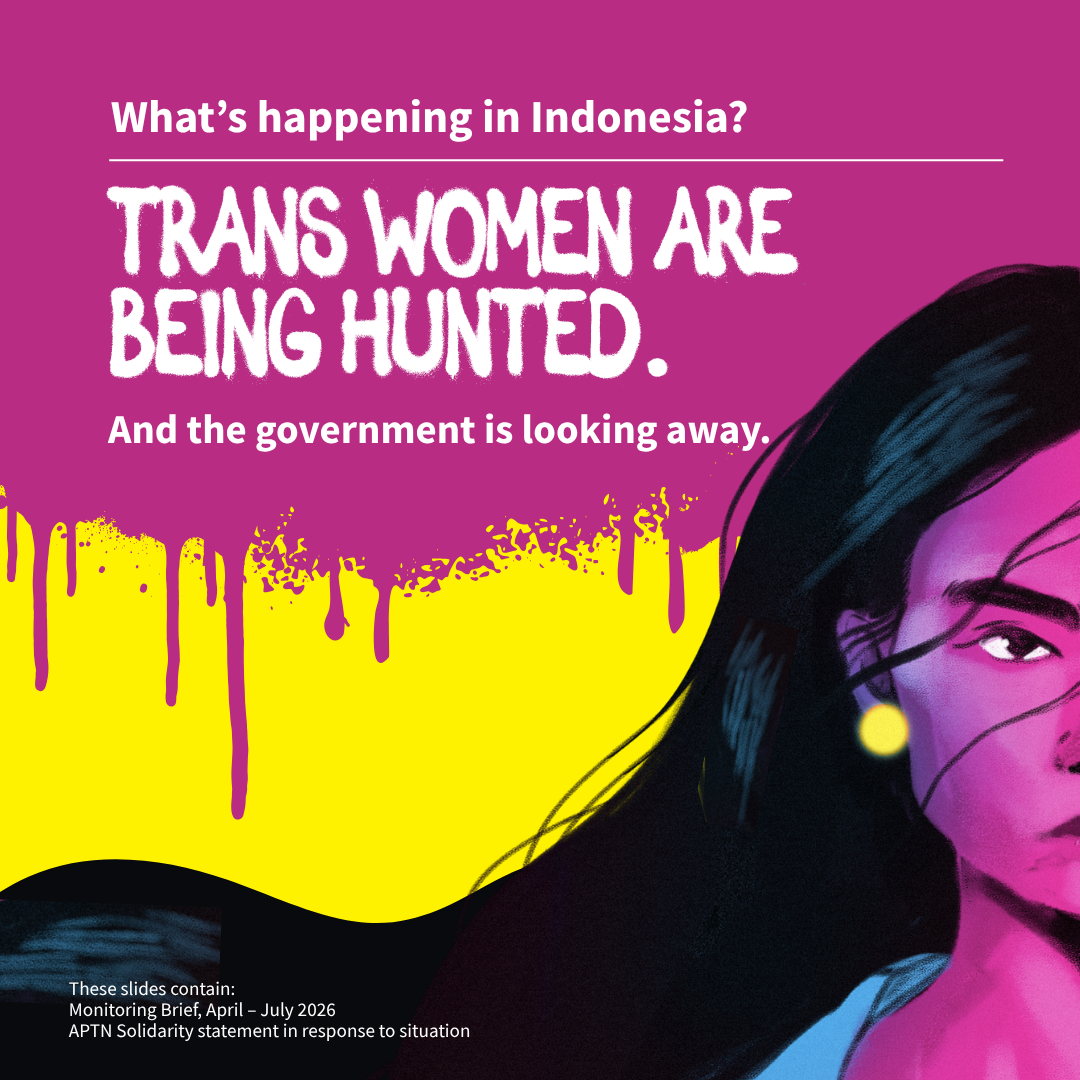
In light of the documented pattern of coordinated attacks unfolding across Indonesia, APTN stands in solidarity with Indonesian transgender communities, community organisations, and human rights defenders. We strongly condemn both the organised violence perpetrated by vigilante groups and the State’s failure to protect those at risk and hold perpetrators accountable. We are equally concerned that discriminatory laws, policies, and official rhetoric have fostered an environment in which such violence can occur with increasing impunity.
Between April and July 2026, Indonesia has experienced an alarming escalation of organised violence targeting LGBTIQ+ people. While the broader LGBTQ+ community has faced increasing hostility, transgender women and sex workers have been disproportionately affected due to their visibility in public spaces, making them the primary targets of coordinated harassment, intimidation, and physical violence.
To date, we have received reports of at least 15 incidents of violence concentrated across three major hotspots—Bogor, Palu, and North Jakarta. Our documented reports indicate that these incidents are neither isolated nor spontaneous, but reflect an emerging pattern of organised vigilante violence targeting LGBTIQ+ people. Groups operating under the banner “Boti Hunter” (which is derogatory slang for “hunters of feminine gay people”) have publicly organised convoys and patrols, with videos of these activities widely circulated online, contributing to fear and encouraging further hostility. The reported incidents include coordinated physical assaults, public humiliation, degrading treatment, intimidation, group attacks, and targeted harassment against transgender women in public spaces. Together, these developments represent a dangerous shift from isolated acts of violence to organised attacks carried out openly in an environment of apparent impunity.
These attacks have unfolded amid an increasingly hostile legal and political environment in which anti-LGBTIQ+ narratives have been normalised through discriminatory laws, government policies, political rhetoric, public discourse, and influential religious and educational institutions. Measures such as Presidential Regulation (Perpres) No. 111 of 2025, which frames the “spread of LGBTQ+ culture” as a non-military threat, alongside local initiatives to profile LGBTQ+ people and introduce discriminatory regulations, have reinforced stigma. Amplified by political figures, high-profile public debates, and other influential actors, these narratives have contributed to an environment in which discrimination and hostility are increasingly tolerated, enabling organised violence to occur with greater impunity. These legal and political stand is the breaches of Indonesia’s obligations under international human rights law—including the International Covenant on Civic and Political Rights (ICCPR) among others—and its leadership role as President of the UN Human Rights Council in 2026, which carry a responsibility to protect all people from violence and discrimination.
Beyond the immediate violence against transgender people, the attacks are increasingly targeting the community protection infrastructure they rely upon for survival. Community organisations, safe shelters, and human rights defenders have become targets of profiling, intimidation, and, in some cases, physical attacks, with reports that a shelter has been damaged. As a result, the National Crisis Response Mechanism, emergency relocation, legal assistance, and psychosocial support are facing growing demand while remaining severely under-resourced, stretching community-led protection efforts beyond their capacity.
APTN calls on the Government of Indonesia to publicly condemn all forms of violence and vigilantism targeting LGBTIQ+ communities, conduct prompt and impartial investigations, hold all perpetrators accountable, and end policies and practices that facilitate the profiling, surveillance, or discrimination of LGBTQ+ people.
We urge international donors, UN agencies, and diplomatic missions to work in close consultation with local organisations to ensure that international engagement strengthens, rather than jeopardises, community-led protection efforts. This includes raising concerns through bilateral and multilateral human rights mechanisms, as well as providing flexible support for emergency protection, including safe shelters, emergency relocation, legal assistance, psychosocial support, and digital and physical security.
Please find the full recommendations below,
Calls on the Government of Indonesia
- Conduct prompt, impartial, independent, and transparent investigations into all reported attacks and ensure that perpetrators are held accountable.
- Publicly condemn all forms of violence, intimidation, and vigilantism targeting transgender people and LGBTQ+ communities.
- End policies and administrative practices that facilitate the profiling, surveillance, or discrimination of LGBTQ+ people.
- Ensure that law enforcement authorities fulfil their obligation to protect all individuals from violence, regardless of gender identity or sexual orientation.
- Guarantee a safe and enabling environment for human rights defenders, community organisations, journalists, and humanitarian responders working to support affected communities.
- Uphold Indonesia’s constitutional guarantees of equality and its international human rights obligations to protect every person without discrimination.
Calls upon diplomatic communities, UN agencies, donors, foundations, international civil society organisations, and development partners to stand in solidarity with Indonesian transgender communities.
International support should prioritise community safety and local leadership by:
- Providing flexible and rapid-response funding for emergency shelters, temporary relocation, legal assistance, psychosocial support, digital and physical security, and other urgent protection needs.
- Supporting community-led documentation, monitoring, and advocacy efforts that strengthen evidence-based responses while respecting confidentiality and informed consent.
- Raising concerns through bilateral engagement, multilateral human rights mechanisms, and diplomatic dialogue, while avoiding actions that could unintentionally increase risks for affected communities.
- Amplifying verified information produced by trusted local organisations rather than sharing sensitive information that could expose survivors, activists, or community networks to further reprisals.
- Consulting closely with local organisations to ensure that international advocacy complements, rather than compromises, community-led protection strategies.
International solidarity must strengthen the resilience and security of affected communities—not increase their visibility in ways that expose them to greater danger.
 News
News

